The tree that defines the Cantabrian mountains
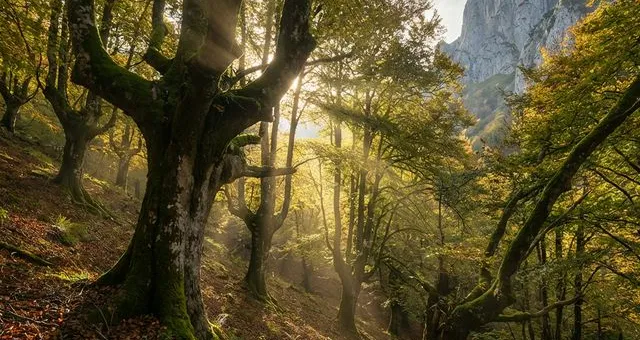
If there is one tree that represents the soul of the mid- and high-mountain landscape of Asturias, it is the beech (Fagus sylvatica). Its forests cover entire hillsides in parks such as Picos de Europa, Redes and Ponga, forming one of the most extensive and best preserved forest ecosystems in northern Spain.
The beech is a demanding tree: it needs high ambient humidity and cool summers, conditions that the Atlantic climate of Asturias provides abundantly at the mid and high altitudes of its natural parks. This is why beech forests usually appear from around 700-800 metres upwards, gradually replacing the oak woodlands that dominate the lower areas.
A canopy that changes colour
What makes the beech forest such a recognisable landscape is its seasonal behaviour:
- Spring: the buds open into an almost luminous, still tender green that lets light filter down to the forest floor.
- Summer: the canopy closes completely and the beech forest becomes a shaded, cool vault, a common refuge from the heat.
- Autumn: the most photographed season. The leaves turn from green to yellow, copper and reddish before falling, colouring entire hillsides in the parks of Picos de Europa, Redes and Ponga.
- Winter: the beech loses all its leaves, revealing the grey, bare structure of the trunks, often covered in moss and lichen.
An ecosystem, not just a tree
Beneath the canopy of a mature beech forest, a characteristic understory develops, with ferns, mosses and a notable variety of fungi that take advantage of the humidity and accumulated leaf litter. Beechnuts, the fruit of the beech, are also an important food resource for forest wildlife in autumn, from wild boar to small rodents and birds.
The wood of the beech has traditionally been used in the area to make tools and, in some cases, as fuel, and beech forests have for centuries been part of the managed landscape of Asturian mountain villages, coexisting with grazing in their clearings and surrounding brañas.
Where to find them
The most representative beech forests of Asturias are concentrated in the higher areas of Picos de Europa, Redes and Ponga, where many of the parks’ hiking routes pass through these forests — especially worthwhile in autumn to enjoy the changing colours, and in winter to appreciate their silence and bare structure under fog or snow.
Routes to walk among beeches
If you want to see for yourself how the beech forest changes with the seasons, these routes are a good starting point:
- Ruta del Hayedo de Lindes (Las Ubiñas–La Mesa) — The route most directly dedicated to an Asturian beech forest, with a dense and well-preserved woodland accessible for most of the year.
- Ruta del Valle de Ponga (Ponga) — Follows one of the valleys with the greatest beech forest cover in the park, especially spectacular during the autumn colour change.
- Ruta del Cares (Picos de Europa) — The gorge is flanked by mixed woodland with beech that intensifies as you gain altitude towards Caín.
Going in autumn? Our guide to autumn hikes in Asturias covers when the beech forests are at their best and six forest hikes to see them.