About the species
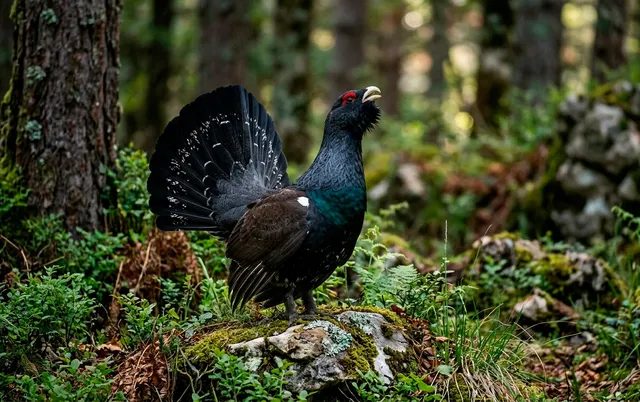
The Cantabrian capercaillie is the most endangered subspecies of the Eurasian capercaillie. With barely a hundred individuals left in the Cantabrian Mountains, it is one of the rarest birds in Europe. Its ancestral spring lekking call is an unrepeatable natural spectacle.
The ghost of the Cantabrian forest
The Cantabrian capercaillie (Tetrao urogallus cantabricus) is undoubtedly the most emblematic and threatened bird in Asturias’s natural parks. This endemic subspecies, genetically different from the Eurasian capercaillie, faces a survival crisis that has brought it to the brink of extinction.
Population status
The latest censuses point to fewer than 100 singing males across the entire Cantabrian range, concentrated mainly in Asturias and León. Redes is one of the last strongholds of the species on the Asturian side.
The lek
Between March and May, males gather at lekking grounds — clearings within the forest — to display before females with their unmistakable song: a series of clicks, gurgles and a final “cork-pop”. The spectacle occurs at dawn and lasts barely a few minutes.
Causes of decline
- Loss and fragmentation of mature forest
- Climate change: the snowline shifts to higher altitudes
- Predation by foxes and corvids on nests and chicks
- Mortality from collisions with fences and power lines
Conservation
The Cantabrian Capercaillie Conservation Programme includes captive breeding with subsequent release, forest habitat management, and the removal of dangerous power lines in areas of presence.
Sightings
Where to spot it


Guided experiences
Guided tours


Actividades gestionadas por Civitatis · Cancelación gratuita hasta 24h antes
For your visit
Recommended gear

Affiliate links — we earn from qualifying purchases.
Keep exploring