About the species
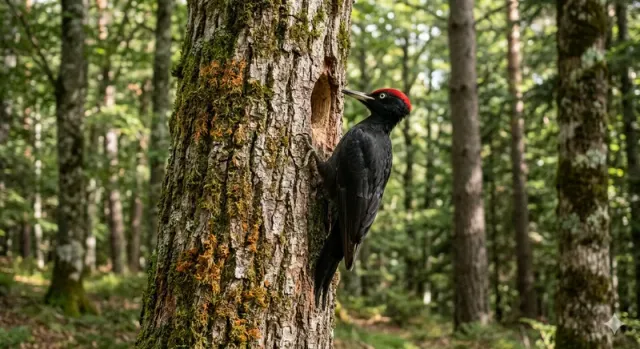
The black woodpecker is Europe's largest woodpecker. With its striking red cap, jet-black silhouette and powerful call echoing through the beech forests, this bird is the emblem of the ancient woodland of the Asturian natural parks.
The carpenter of the beech forest
The black woodpecker (Dryocopus martius) is Europe’s largest woodpecker and one of its most elusive. Its presence in a forest guarantees ecological maturity and quality: it needs large, old trees in which to excavate its nests and find food.
Unmistakable appearance
The black woodpecker measures 45–57 cm with a wingspan of almost 90 cm. Its plumage is entirely jet black, except for a brilliant red cap that covers the whole head in males and is limited to the nape in females. Its long, powerful bill works like a chisel, capable of excavating solid wood with ease.
The architect of the forest
The cavities the black woodpecker excavates in old trees are not just its own nest — they become essential refuges for dozens of other species. Bats, tawny owls, blue tits and even pine martens use these holes once the woodpecker has abandoned them. For this reason the black woodpecker is considered a keystone species of the forest ecosystem.
The Muniellos reserve
The Muniellos forest in the Fuentes del Narcea Natural Park is one of the best places in Spain to observe the black woodpecker. Its centuries-old beech and oak woods, barely touched by human activity for generations, offer exactly what this woodpecker needs: large dead or weakened trees full of beetle larvae.
How to detect it
You will hear it before you see it. Its call — a powerful klee-klee-klee audible over a kilometre away — and its rhythmic drumming on trunks are the best clues. Spring dawns, when males are marking territory, are the best time to locate this magnificent bird.
Sightings
Where to spot it


Keep exploring