About the species
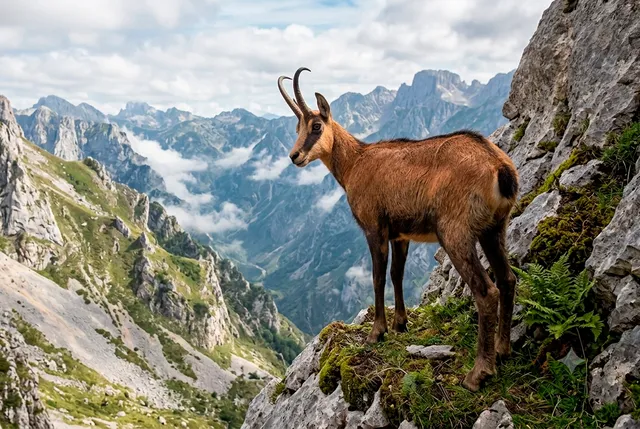
The Cantabrian chamois is the most agile ungulate in the Asturian parks. Its ability to move with astonishing speed across rocky, precipitous terrain makes it one of the most fascinating animals of the high mountain. Populations are stable thanks to decades of protection.
The acrobat of the crags
The Cantabrian chamois (Rupicapra pyrenaica parva) is the smallest subspecies of the Rupicapra genus and one of three recognised on the Iberian Peninsula, alongside the Pyrenean chamois and the isard. In Asturias, the most important populations are found in the Ponga, Redes and Ubiñas-La Mesa parks.
Physical characteristics
It weighs between 15 and 35 kg and stands about 65–80 cm at the shoulder. Both sexes have horns, curved backwards at the tip — the characteristic “hook”. In summer the coat is reddish-brown; in winter, almost black with white markings on the face.
Behaviour and sociability
For most of the year it lives in groups separated by sex. Females form family herds with their young; males are solitary or gather in small bachelor groups. Both sexes only mix during the rut in November–December.
Where to spot it
The best observation points in Asturias are:
- Ponga: Viewpoints around Pico Gorrión and the Dobra Gorge
- Redes: High zones around the Puerto de Tarna pass
- Ubiñas: Glacial cirques below Ubiña Grande peak
Sightings
Where to spot it


Guided experiences
Guided tours
Actividades gestionadas por Civitatis · Cancelación gratuita hasta 24h antes
For your visit
Recommended gear

Affiliate links — we earn from qualifying purchases.
Keep exploring